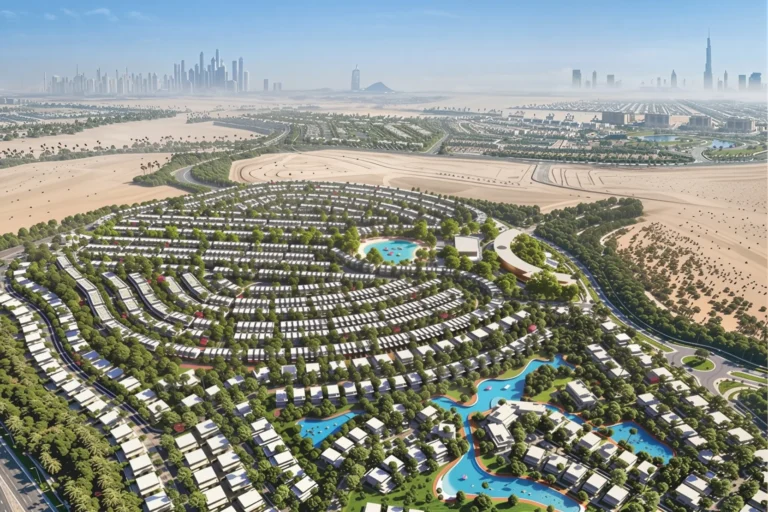
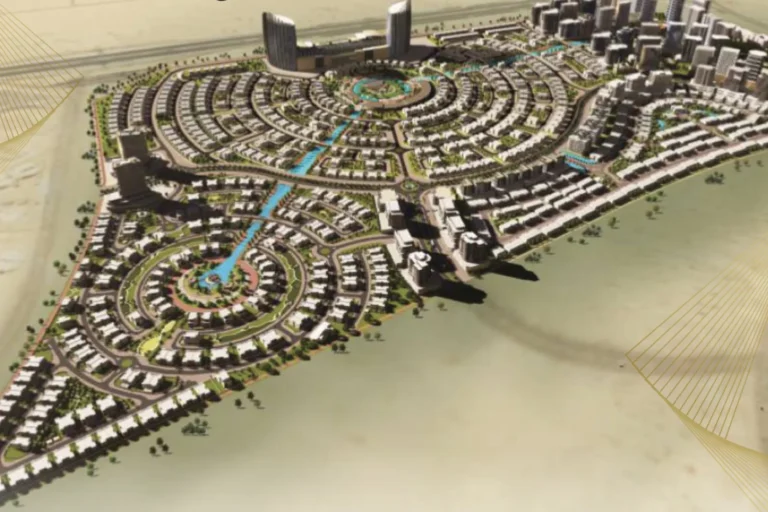
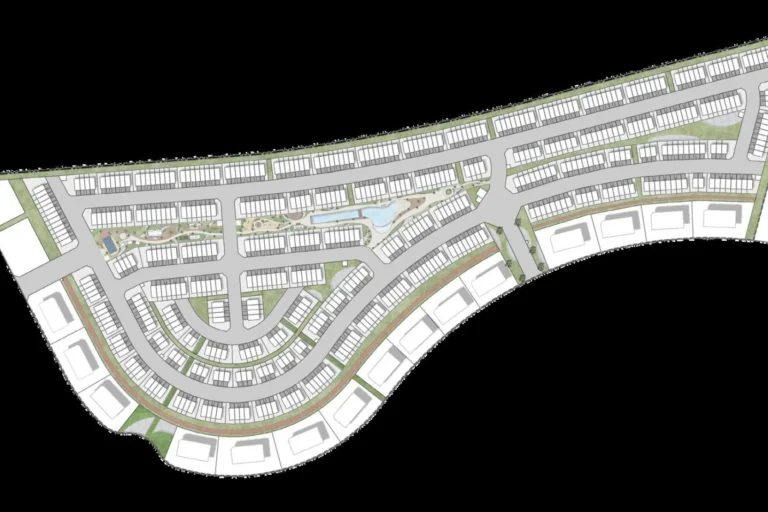
Desert Rose City is a large-scale, masterplanned urban project located just east of Academic City in Dubai. Conceived as a sustainable city, it received government approval in 2014 and progressed through municipal approvals and detailed design stages in 2016. The scheme is intended to combine residential neighbourhoods with onsite utilities, public services and a substantial peri-urban green belt, all organised to reduce the development’s environmental footprint.
Desert Rose City is a purpose-built township project whose concept emphasises self-sufficiency and low-carbon infrastructure. The masterplan is expected to provide 30,000 residences, with two thirds of units reserved for Emirati nationals and one third for expatriates. The development lies immediately east of Academic City, with an adjacent 700-hectare green belt planned alongside the Al Etihad Rail alignment.
The green belt is intended as both a buffer and landscape reserve for the new city, with areas for agricultural production and outdoor recreation. The overall design includes neighbourhood services such as schools, shopping centres, clinics and hospitals, mosques, a police station and other community amenities to support a full-time residential population.
Public transport connections for Desert Rose City are planned rather than existing. A seven-kilometre light rail line has been proposed to link the township with the Dubai Metro Green Line. The wider area is served by the Dubai Metro Red Line, with station R11 approximately 15,035 metres from the site; this distance is not considered walkable.
Internal mobility is planned through local streets, pedestrian routes and an extensive 25-kilometre eco-walk looping around the community. The eco-walk is intended to provide a continuous, car-minimised recreational circuit for residents and visitors.
The German International School Dubai is approximately 5.4 km from the Desert Rose City site.
The project is positioned as an environmentally focused development and includes several engineered systems to support that aim. A 200-megawatt renewable-energy plant forms part of the design and is intended to supply roughly 40 per cent of the city’s electrical demand. Rooftop photovoltaic arrays are specified across the built environment, alongside a dedicated waste recycling facility. Water production for potable supply is also incorporated into the infrastructure, with a design output of 40,000 gallons of drinking water.
Desert Rose City aims to reduce its overall carbon footprint by 300,000 tonnes per year. Buildings within the masterplan are designed with eco-friendly construction and operational measures intended to support these sustainability goals.
The project received initial government approval in May 2014, followed by municipal approval in July 2016 and progression to detailed design in October 2016. The overall programme has a cited capital cost of AED 30 billion and envisages residential neighbourhoods supported by civic and commercial uses.
The city is planned to include a full range of community services, including schools, shopping centres, clinics and hospitals, places of worship and a police station. The intention is to create a self-sustaining neighbourhood where residents can access daily services within the development’s planned boundaries.
As a single, large masterplan, the delivery of these facilities is phased alongside housing and infrastructure.
Is Desert Rose City already built?
Desert Rose City progressed from initial government approval in May 2014 to municipal approval and detailed design stages in 2016. It remains a masterplanned project.
How many homes will be in Desert Rose City?
The masterplan describes 30,000 residences, with roughly two thirds reserved for Emirati nationals and one third for expatriates.
What sustainability features are included?
The masterplan incorporates a 200 MW renewable-energy plant intended to supply about 40 per cent of electricity demand, rooftop solar across buildings, a waste recycling facility and potable-water production capacity of 40,000 gallons. The design aims to reduce carbon emissions by 300,000 tonnes per year.
What transport connections are planned?
A seven-kilometre light rail line is proposed to connect Desert Rose City to the Dubai Metro Green Line. Dubai Metro Red Line station R11 is about 15,035 metres from the site and is not considered walkable.
Machine-readable mirrors of this page: Markdown · JSON. Every field carries its origin.
How to cite:Desert Rose City — Continental Club Property, 2026-07-30, https://continentalclub.ae/location/desert-rose-city/
Dubai market as a whole: prices, transactions and trends (DLD data) →
Neighbouring areas and sub-communities to compare location and prices.