Updated: 8 September 202621 min read
Dubai Hills has become one of the most talked‑about master communities in Dubai over the last decade. Planned and developed by two major government‑related developers, Emaar Properties and Meraas Holding, it combines modern residential clusters, a large golf course, landscaped parks and a growing retail and business hub. For end users and investors, it offers a mix of apartments, townhouses and villas at different price points, with the additional upside of ongoing development and future infrastructure improvements.
This guide explains how Dubai Hills is structured, what makes it attractive, what drawbacks buyers should be aware of, and how pricing and yields look for different property types. It also reviews several notable projects within the community, including Maple At Dubai Hills Estate, Dubai Hills Vista, Park Horizon, Lime Gardens and Golf Grove.
Why the Dubai Hills Community Is Attractive
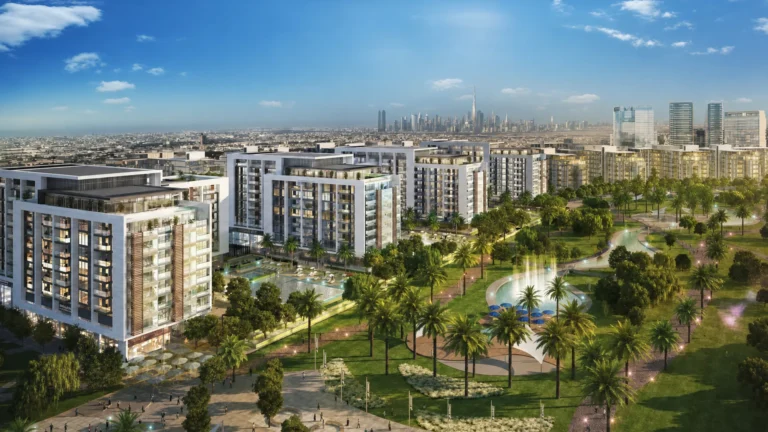
Dubai Hills is positioned as a large, master‑planned community with a strong focus on lifestyle, green spaces and family‑oriented living. Construction started in 2014 under Emaar Properties and Meraas Holding, and the area has been rapidly evolving since then. Its master plan combines residential clusters, retail, offices, schools, hotels and extensive sports and leisure facilities.
Strategic Location and Transport Connectivity
One of the core advantages of Dubai Hills is its location relative to key parts of Dubai. The community offers the following approximate travel times by car:
- About 10 minutes to the central areas of Dubai.
- About 20 minutes to Dubai International Airport.
- About 15 minutes to the nearest public beach.
For many buyers, especially those working in business districts or frequently travelling, this balance between central accessibility and a quieter residential environment is a major draw. The master plan also includes the launch of shuttle services and the construction of two new metro stations in the future. While these are not yet operational, their planned introduction is an important factor for long‑term investors who consider future public transport as a driver of demand and capital appreciation.
Integrated Urban Infrastructure
Dubai Hills is designed as a self‑contained community with a broad mix of uses. According to the master plan, the area will include:
- A large shopping mall with a total area of about 140,000 m².
- Almost 200,000 m² of office space.
- Three luxury hotels.
- Four schools.
- Multiple sports and leisure facilities.
The presence of a major shopping centre within the community is particularly important for both residents and investors. It typically increases footfall, supports retail and F&B outlets, and makes the area more attractive for tenants who prefer to have shopping and entertainment within a short drive or even walking distance from home.
The planned office space also matters from an investment perspective. When office clusters are integrated into a residential master community, they can create a local employment base and support demand for nearby rental properties. For Dubai Hills, almost 200,000 m² of offices means a significant number of potential white‑collar tenants in the medium to long term.
Sports and Lifestyle Facilities
Dubai Hills has a strong focus on active lifestyle and sports. The community plan includes:
- A tennis academy.
- Volleyball courts.
- Basketball courts.
- A skate park.
- A swimming pool.
These facilities are important for both families and younger professionals who value on‑site sports infrastructure. From an investment standpoint, such amenities can support higher occupancy and help justify premium rents compared with more basic communities.
Green Environment and Dubai Hills Golf Club
One of the main selling points of Dubai Hills is its environmental concept. The community is planned with:
- Landscaped parks and gardens.
- Cycling routes.
- Extensive green belts around residential clusters.
At the heart of the community is an international golf course, Dubai Hills Golf Club. Properties around golf courses in Dubai typically command a premium due to open views, lower building density and the overall lifestyle associated with golf communities. In Dubai Hills, about 100 villas are planned near the golf course, which positions them as a niche product for buyers seeking both exclusivity and direct golf views.
For families, the combination of parks, cycling paths and sports facilities creates a strong value proposition: children can spend more time outdoors, and adults have easy access to recreational activities without leaving the community.
Family‑Friendly Character and Demand for Villas and Townhouses
Dubai Hills is particularly popular among family buyers. The community is among the top five areas in Dubai by sales of villas and townhouses. This is driven by several factors:
- Availability of spacious homes with 3–5 bedrooms.
- Planned schools within the community.
- Green surroundings and parks.
- Sports and leisure infrastructure.
At the same time, Dubai Hills is not limited to large family homes. The community also offers apartments for buyers and tenants who do not need an entire villa or townhouse. This mix of property types allows investors to target different segments: from single professionals and young couples to large families looking for premium villas.
New Developments in Dubai Hills and the Wider UAE Context
Related Articles
- ROI analysis of apartment in Zanzebeel 3: DLD data and real deals
- How to sell a home in Dubai in Samana Manhattan 1 – analysis 2025
- How to buy a home in Dubai in Paramount Tower Hotel & Residences – analysis 2026
- How to sell a property in Dubai in Azizi Venice 6 – analysis 2026
- How to sell an unit in Dubai in One B Tower – analysis 2026
Within the broader context of new developments in the UAE, Dubai Hills stands out as a large, master‑planned project led by established government‑related developers. For investors comparing different new communities, several structural aspects of Dubai Hills are important:
Scale of the Master Plan
The Dubai Hills project provides for the construction of more than 20,000 apartments and about 4,500 villas. Within this villa stock, around 100 villas are planned directly adjacent to the golf course. This scale means that Dubai Hills is not a small niche project but a major residential hub that can influence the balance of supply in its segment.
For investors, a large master community can offer several advantages:
- Diversified stock of properties across different clusters and price levels.
- Phased delivery of projects, which can create multiple entry points over time.
- Continuous improvement of infrastructure as more phases are completed.
At the same time, the scale also means that construction activity will continue for a number of years, which has implications for current residents and short‑term investors, as discussed later.
Developer Profile and Off‑Plan Purchases
Dubai Hills is being developed by Emaar Properties and Meraas Holding, both of which are large, state‑linked developers with a strong track record in Dubai. For buyers considering off‑plan purchases, developer reputation is a key risk‑mitigation factor. In Dubai Hills, many projects have already been completed and handed over, while others are still under construction or at planning stages.
Because the community is still being built out, buyers have the opportunity to purchase properties at the planning or early construction stage. In Dubai, such off‑plan purchases are often used as an investment strategy: buyers enter at lower prices and aim to benefit from capital appreciation as the project nears completion and the surrounding infrastructure improves.
In the context of the UAE new‑build market, Dubai Hills fits into the category of large, master‑planned communities with a long development horizon, where both end users and investors can find suitable options depending on their risk tolerance and investment horizon.
Drawbacks and Risks of Buying in Dubai Hills
Despite its many advantages, Dubai Hills also has several drawbacks that buyers and investors should consider when making decisions.
Ongoing Construction and Noise
One of the main disadvantages of Dubai Hills at this stage is the scale of ongoing construction. The community is large, and many plots are still under development. This leads to:
- Construction noise in certain clusters.
- Temporary traffic diversions or roadworks.
- Visual impact of cranes and construction sites in some views.
For end users planning to move in immediately, this can affect daily comfort, especially if their chosen building is close to active construction zones. For investors, construction can influence short‑term rental appeal in specific sub‑communities, although it is typically seen as a temporary issue that diminishes as more phases are completed.
Limited Public Transport at Present
Another current drawback is the lack of operational public transport within Dubai Hills. At the moment, residents primarily rely on:
- Private cars.
- Taxi services.
While the master plan includes two metro lines and shuttle services, these are future elements and not yet available. For tenants and buyers who do not drive or prefer to live near existing metro stations, this can be a limiting factor. However, for car‑owning families and professionals used to commuting by car, this drawback is often offset by the community’s road connectivity and lifestyle advantages.
Property Prices and Yields in Dubai Hills
Dubai Hills offers a range of property types, from apartments and studios to premium villas and townhouses. The community caters to different budgets and investment strategies, while maintaining a generally mid‑ to upper‑segment positioning.
Villas and Townhouses: Pricing and Rental Yield
Dubai Hills is particularly strong in the villa and townhouse segment. The average price for villas with 3–5 bedrooms is around USD 2,700 per square metre. This figure reflects the positioning of Dubai Hills as a premium but still relatively accessible golf and park community compared with ultra‑luxury waterfront or island projects.
In terms of investment performance, villas in Dubai Hills show an annual yield in the range of 4–5%. This yield level is typical for quality villa communities in Dubai that combine strong end‑user demand with limited direct competition in the immediate vicinity.
For investors, several factors influence villa yields in Dubai Hills:
- Number of bedrooms (3–5 bedroom configurations appeal to families).
- Proximity to parks, schools and the golf course.
- Quality of finishes and whether the property is furnished.
- Availability of community facilities within walking distance.
While yields of 4–5% may be slightly lower than some smaller apartment units in more central or purely rental‑driven areas, they are often balanced by stronger end‑user demand and potential for stable long‑term occupancy.
Apartments: Entry Prices and Yield
Dubai Hills also offers a wide range of apartments, which are attractive both to first‑time buyers and to investors seeking more affordable entry points. Indicative pricing for apartments in Dubai Hills is as follows:
- One‑bedroom apartments from about USD 170,000.
- Two‑bedroom apartments from about USD 260,000.
- Three‑bedroom apartments from about USD 330,000.
The average yield for apartments in Dubai Hills is around 5.5% per year. This is higher than the villa yield range and reflects the typical pattern in Dubai where smaller units often generate higher percentage rental returns due to lower absolute prices and strong demand from young professionals and small families.
For investors, one‑ and two‑bedroom apartments in Dubai Hills can be particularly attractive because they combine:
- Relatively low entry prices compared with villas.
- Strong tenant demand driven by the community’s lifestyle offering.
- Potential for capital appreciation as more infrastructure and amenities are delivered.
Three‑bedroom apartments, while more expensive, can target larger families who want to live in Dubai Hills but are not ready to purchase or rent a full villa or townhouse.
Capital Appreciation Potential
Because Dubai Hills is still under development, there is an opportunity to benefit from price growth as the community matures. Buyers who enter at the planning or early construction stage may see capital appreciation as:
- More residential phases are handed over.
- The large shopping mall and office spaces become operational.
- Schools and hotels open and attract more residents and visitors.
- Future shuttle services and metro stations are implemented.
For investors, this combination of rental yield and potential capital appreciation is a key reason to consider Dubai Hills as part of a diversified Dubai real estate portfolio.
How to Buy Property in Dubai Hills
Buying property in Dubai Hills follows the general structure of property acquisition in Dubai, with some specific considerations related to developer sales and brokerage services.
Buying Directly from the Developer
One option is to purchase directly from the developer. In Dubai Hills, this typically means buying from Emaar Properties or, in some cases, from other developers operating within the master community. Direct developer purchases are common for off‑plan properties and newly launched phases.
When buying directly from the developer, buyers usually go through the following steps:
- Selecting a specific project and unit type (apartment, townhouse, villa).
- Reviewing the payment plan and construction timeline.
- Signing the sales and purchase agreement with the developer.
- Registering the off‑plan contract with the relevant authorities.
Developers often offer structured payment plans for off‑plan properties, which can be attractive for buyers who prefer staged payments over a period of construction. However, buyers should carefully assess their own financial capacity and investment horizon, as well as the expected completion dates.
Buying Through Brokerage Companies
Another common route is to purchase through brokerage companies. In Dubai Hills, many local and international brokerages are active, offering both off‑plan and ready properties. Working with a brokerage can provide several advantages:
- Access to a wider selection of units across multiple projects.
- Professional assistance in comparing layouts, views and building locations.
- Support with negotiations on price and payment terms where applicable.
- Legal support and coordination of documentation.
- Assistance with mortgage arrangements.
For foreign buyers unfamiliar with Dubai’s property market structure, brokerage support can be particularly valuable. Brokers can explain typical transaction costs, timelines and regulatory requirements, and help coordinate with banks and legal advisors.
Mortgage and Legal Support
Many buyers in Dubai Hills use mortgage financing to acquire property. Brokerage companies often assist with:
- Identifying suitable banks and mortgage products.
- Preparing the required documentation.
- Coordinating property valuation and bank approvals.
Legal support is also important, especially for off‑plan purchases and for buyers who are new to the Dubai market. Professional advisors can help review contracts, explain obligations and ensure that all registrations and payments are handled correctly in line with local regulations.
Notable Projects in Dubai Hills
Within Dubai Hills, several projects stand out due to their concept, location or pricing. Below is an overview of five such projects: Maple At Dubai Hills Estate, Dubai Hills Vista, Park Horizon, Lime Gardens and Golf Grove.
Maple At Dubai Hills Estate
Maple At Dubai Hills Estate is a cluster of ready townhouses positioned within the broader Dubai Hills community. The project focuses on family‑oriented living with an emphasis on green surroundings and community facilities.
Key characteristics of Maple At Dubai Hills Estate include:
- Ready townhouses with three bedrooms.
- Pricing for three‑bedroom townhouses from about USD 490,000.
- Green areas integrated into the community design.
- Sports grounds and recreational spaces for residents.
For buyers, Maple offers the advantage of immediate occupancy, which is important for end users who do not want to wait for construction completion. For investors, ready townhouses can start generating rental income without construction risk.
The presence of green zones and sports grounds enhances the appeal of Maple for families with children and for tenants who value outdoor activities. This can support both occupancy and rental rates compared with more basic townhouse communities.
Dubai Hills Vista
Dubai Hills Vista is a villa project within Dubai Hills that targets the upper segment of the market. It is characterised by large villa sizes and premium positioning.
Key features of Dubai Hills Vista include:
- Villas with a built‑up area of about 750–850 m².
- Six‑bedroom configurations.
- Expected completion at the end of 2026.
- Views of the golf course and the city.
These villas are designed for buyers seeking substantial living space, privacy and premium views. The combination of golf course and city views is a strong differentiator within Dubai Hills and can support both end‑user demand and long‑term value.
Because Dubai Hills Vista is still under construction with completion expected at the end of 2026, it is primarily an off‑plan investment at this stage. Buyers considering this project should evaluate their investment horizon and risk tolerance, as well as the potential for capital appreciation as the handover date approaches and the surrounding infrastructure continues to develop.
Park Horizon
Park Horizon is a premium residential complex within Dubai Hills that combines apartments and two‑storey townhouses. It is positioned as a higher‑end product within the community, appealing to buyers who want a modern building with direct access to parks and community facilities.
Key aspects of Park Horizon include:
- Two‑storey townhouses integrated into the complex.
- Apartments with 1–3 bedrooms.
- Expected completion in the third quarter of 2026.
- Prices starting from about USD 495,000 for apartments of around 95 m².
For investors, Park Horizon offers a mix of unit types that can target different tenant profiles. One‑bedroom apartments may appeal to single professionals and young couples, while two‑ and three‑bedroom units and townhouses can attract families who want to live near parks and community amenities.
The expected completion in the third quarter of 2026 means that buyers are currently looking at an off‑plan timeline. This can provide an opportunity to enter at launch or early‑stage pricing, with the expectation of value growth as the project nears handover and the Dubai Hills community continues to mature.
Lime Gardens
Lime Gardens is another residential project within Dubai Hills, consisting of multiple buildings with a focus on apartment living. It offers a more segmented delivery schedule, with some buildings already completed and others still under construction.
Key characteristics of Lime Gardens include:
- A total of 35 buildings in the project.
- Three buildings already completed.
- One‑bedroom apartments from about 60 m².
- Prices for one‑bedroom units starting from about USD 305,000.
For buyers, Lime Gardens provides both ready and off‑plan options within the same overall project, depending on the specific building. This can be useful for investors who want to diversify between immediate rental income and future capital appreciation within a single community.
The relatively compact size of one‑bedroom units (from about 60 m²) and their starting price point make Lime Gardens an accessible entry into Dubai Hills for first‑time buyers and smaller investors. At the same time, the project benefits from the broader Dubai Hills infrastructure, including parks, retail and sports facilities.
Golf Grove
Golf Grove is a villa project within Dubai Hills that focuses on more compact villa formats compared with some of the larger golf‑side villas in the community. It is designed for buyers who want a villa lifestyle near the golf course but do not require extremely large built‑up areas.
Key features of Golf Grove include:
- Compact villas with 3–4 bedrooms.
- Built‑up areas from about 270 m².
- A mix of completed and under‑construction homes.
- Turnkey finishing and furnishing.
- Prices starting from about USD 831,000.
For end users, Golf Grove offers the advantage of moving into a finished villa with turnkey finishing and furnishing, which reduces the time and cost associated with interior fit‑out. For investors, furnished villas can be easier to rent out, especially to expatriate families arriving in Dubai who prefer ready‑to‑move‑in homes.
The combination of 3–4 bedroom layouts and proximity to the golf course positions Golf Grove as a mid‑ to upper‑segment product within Dubai Hills, appealing to families who value both lifestyle and location.
Who Should Consider Buying in Dubai Hills?
Dubai Hills can be suitable for several categories of buyers and investors, depending on their objectives and budgets.
End‑User Families
Families looking for a long‑term home in Dubai may find Dubai Hills particularly attractive due to:
- Availability of 3–5 bedroom villas and townhouses.
- Planned schools within the community.
- Parks, cycling routes and sports facilities.
- Reasonable driving times to central Dubai and the airport.
For such buyers, the main considerations are likely to be budget, preferred property type (apartment vs townhouse vs villa) and tolerance for ongoing construction in certain parts of the community.
Yield‑Focused Investors
Investors primarily focused on rental yield may look closely at:
- One‑ and two‑bedroom apartments with average yields around 5.5%.
- Ready projects like Maple At Dubai Hills Estate and completed buildings in Lime Gardens.
- Furnished villas in projects such as Golf Grove for family tenants.
These investors typically prioritise stable tenant demand, manageable service charges and the ability to rent out units quickly due to the community’s lifestyle appeal.
Capital Appreciation‑Oriented Investors
Investors who are more focused on capital appreciation may consider off‑plan projects with completion dates in 2026, such as Dubai Hills Vista and Park Horizon, as well as under‑construction phases in Lime Gardens and Golf Grove. Their strategy may involve:
- Entering at early‑stage pricing.
- Holding through construction and initial handover.
- Exiting once the project is completed and the surrounding infrastructure is fully operational.
For such investors, careful analysis of payment plans, construction timelines and the broader market cycle is essential.
Conclusion: Dubai Hills as a Balanced Investment and Lifestyle Choice
Dubai Hills combines several key elements that are important for both end users and investors in Dubai’s real estate market: strategic location, large‑scale master planning, strong family orientation, extensive green and sports infrastructure, and a wide range of property types and price points.
The community’s advantages include:
- Proximity to central Dubai, the airport and beaches.
- Planned shopping mall, office spaces, hotels and schools.
- Dubai Hills Golf Club and extensive parks and cycling routes.
- Diverse housing options from studios and one‑bedroom apartments to premium 3–5 bedroom villas.
Its drawbacks mainly relate to the current stage of development: ongoing construction, associated noise and the temporary absence of public transport within the community. However, the planned introduction of shuttle services and two metro stations, along with the continued delivery of infrastructure, supports the long‑term investment case.
For buyers and investors who are comfortable with a developing environment and who value a green, family‑oriented community with strong future potential, Dubai Hills represents a compelling option within the Dubai property market. Whether the goal is to secure a primary residence, generate rental income or benefit from capital appreciation as projects complete through 2026, Dubai Hills offers a structured and diversified platform for real estate investment.
See also: where renting is cheapest.