Jebel Ali Wetland Sanctuary is a coastal nature reserve located in the Jebel Ali area of southern Dubai (listed on site path as Dubai > Hessyan Second > Jebel Ali Wetland Sanctuary). Recognised for its ecological value, the sanctuary contains extensive intertidal habitat, seagrass beds and nearshore reefs that support a wide range of bird, fish, reptile and marine mammal species. In October 2018 the area was added to the Ramsar List of Wetlands of International Importance, giving it formal international recognition as a wildlife habitat of significant value.
The Jebel Ali Wetland Sanctuary is one of the remaining undeveloped coastal and marine areas in Dubai. It comprises tidal flats, mangrove and seagrass communities and adjacent shallow waters. The sanctuary functions primarily as a wildlife habitat and ecological refuge rather than as an urban or residential neighbourhood. Its position within the greater Jebel Ali area places it on Dubai’s southern coastal corridor, beyond the principal built-up clusters that extend along the city’s central coastline.
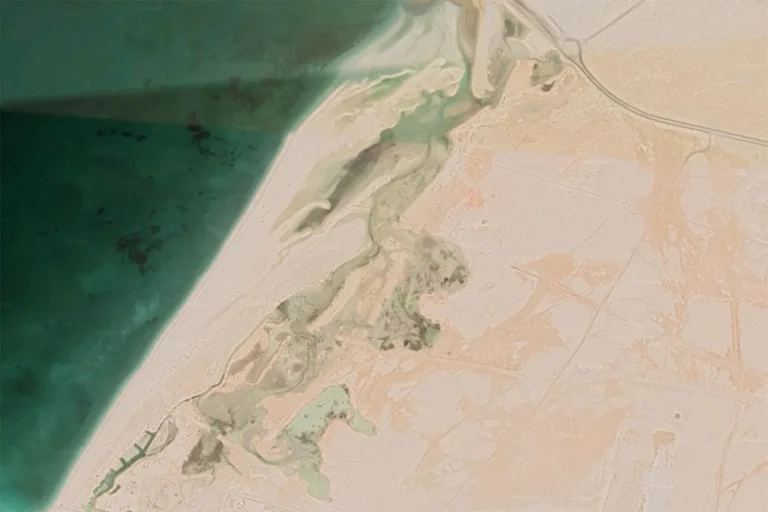
The sanctuary supports a documented diversity of species. Field surveys and official descriptions note 124 bird species and 147 fish species recorded in the area. Fish observations include species such as the orange-spotted grouper, the mottled eagle ray, the Arabian carpet shark and the whale shark. Marine reptiles recorded in the vicinity include sea turtles, with the green turtle and the endangered hawksbill turtle specifically cited. Coral diversity is present as well, with more than 30 types of coral recorded in the adjacent sea. The site’s marine mammals are noted as part of the fauna associated with the area’s seagrass and reef systems.
Designation on the Ramsar List underlines the sanctuary’s role as a site of international importance for wetland biodiversity and as a habitat for species that use the area for feeding, breeding or migration. Management priorities associated with Ramsar sites typically include protection of habitat values, monitoring of species, and maintaining the ecological character of the site.
Public transport access to the sanctuary is limited. The nearest Dubai Metro reference in available material is a Red Line station coded R42, located approximately 18,294 metres from the sanctuary; this distance is not considered walkable for routine access. For private transport, typical driving times quoted for journeys from the sanctuary to major Dubai landmarks are as follows:
These estimates reflect travel from the sanctuary to central and recreational destinations across Dubai and indicate that the site lies on the outer side of the city’s main built-up zones; travel times will vary with traffic conditions and chosen routes.
The Jebel Ali Wetland Sanctuary is described as an undeveloped and protected natural area. The site’s primary role is ecological conservation rather than urban development. There are no residential masterplans or commercial building projects identified as internal components of the sanctuary itself. Surrounding parts of Jebel Ali host a variety of urban, industrial and logistics uses, but the sanctuary remains distinct as a coastal conservation parcel with recognised environmental status.
The sanctuary is principally of interest to people whose priorities are connected to nature, wildlife observation, scientific study and conservation. It will also be relevant to stakeholders involved in environmental management, coastal ecology and biodiversity monitoring. For those seeking conventional residential neighbourhoods, shopping, leisure complexes or standard urban amenities, nearby established zones of Jebel Ali and other coastal developments remain the typical options; the sanctuary serves a different purpose as a protected ecological resource.
Is Jebel Ali Wetland Sanctuary officially protected?
The area has been added to the Ramsar List of Wetlands of International Importance (October 2018), a formal recognition that highlights its conservation value.
What wildlife can be seen there?
Recorded fauna include 124 species of birds and 147 species of fish. Notable marine animals documented in association with the site include the orange-spotted grouper, mottled eagle ray, Arabian carpet shark and whale shark; turtles such as the green turtle and the endangered hawksbill turtle are also recorded. Coral communities of more than 30 types contribute to the local marine biodiversity.
How do I get there by public transport?
Public transport links are limited. The nearest referenced metro station is on the Red Line (code R42) at a distance of roughly 18.3 km from the sanctuary, a distance that is not considered walkable for routine access. Private vehicle travel is the common way to reach the site.
How far is the sanctuary from Dubai’s main attractions and airports?
Typical driving times quoted are approximately 43 minutes to Dubai Mall, 35 minutes to Palm Jumeirah, 40 minutes to Burj Al Arab, 36 minutes to The Walk JBR, 51 minutes to Dubai International Airport (DXB) and 35 minutes to Al Maktoum International Airport. Actual travel times depend on traffic and route.
Machine-readable mirrors of this page: Markdown · JSON. Every field carries its origin.
How to cite:Jebel Ali Wetland Sanctuary — Continental Club Property, 2026-07-30, https://continentalclub.ae/location/jebel-ali-wetland-sanctuary/
Dubai market as a whole: prices, transactions and trends (DLD data) →
Neighbouring areas and sub-communities to compare location and prices.
